5 questions for a PM tool review in 2026
A short rubric to separate tools that look good from tools that drive real impact. It is vendor-agnostic on purpose, including against us.
If you lead product, someone on your team has probably asked you quietly: are we still on the right PM tool?
It is a fair question. AI features, product pivots, and falling switching costs have moved the review from the back of the list to the top.
What follows is a short rubric: 5 questions you can use on any PM tool on your shortlist, including the one you already pay for. Including us.
We think these 5 questions matter more than any feature grid. The grid will still be useful, but it answers a question from 2021. These 5 answer the question from 2026.
Before the questions, a framing worth holding.
2 postures
A software tool can take 1 of 2 postures toward the team that pays for it.
Invested in you. Every release sharpens the product you already bought. The roadmap is tuned to what your stack does well. The upgrades compound the decision you made. The vendor's ambition and your outcome are aligned because the vendor's ambition is to be a better version of the thing you chose.
Needing your investment. Every release is an attempt to become something the tool was not originally. The roadmap is tuned to what the vendor is trying to become. Your fees are capital for that journey. You might still get a good tool in the end. You might not. Either way, you are in a different relationship than the one the pricing page implies.
Most product leaders can tell the difference when they look carefully at 2 years of release notes. The rhythm of a tool invested in you reads like we heard you. The rhythm of a tool needing your investment reads like we have a new direction.
Neither posture is dishonorable. The second has produced some of the great pivots in software history. But the second is also how teams end up paying a premium to subsidize a reinvention that may or may not arrive. Knowing which posture your tool has taken is the precondition for any serious evaluation.
The grid will still be useful. But the grid answers a question from 2021. These 5 questions answer the question from 2026.
With that frame, the rubric.
Question 1: Can we trace any recommendation back to customer signal?
This is the most important question in the rubric. It is also the question the most vendors answer badly.
A product operating system worth paying for should be able to show you, for any recommendation it makes, the exact signals that produced the recommendation. Which calls. Which tickets. Which deals. Which segments. Which conversations. Not a summary of the signal. The chain.
If the vendor can tell you why a recommendation was made but cannot show you what it was made from, you are building your roadmap on a foundation you cannot inspect. A visible error can be corrected. A plausible answer with no source trail can quietly become roadmap truth.
Good answer: 1 click from initiative back to source. Who said it, when, in what context, how it connects to the outcome. The chain is 1 link, not a research project.
Red flag: manual links, screenshots stitched together by the PM, or a version of "trust me." If the trail requires the PM to rebuild it from memory, the system is not the system; the PM's head is.
A concrete way to bring this into the meeting: ask the vendor to take any recommendation the tool made this quarter and click through to the evidence. Count clicks. Watch what happens when you ask to share the chain with engineering in a single link. The answer to that small request tells you whether the system was built around traceability or around presentation.
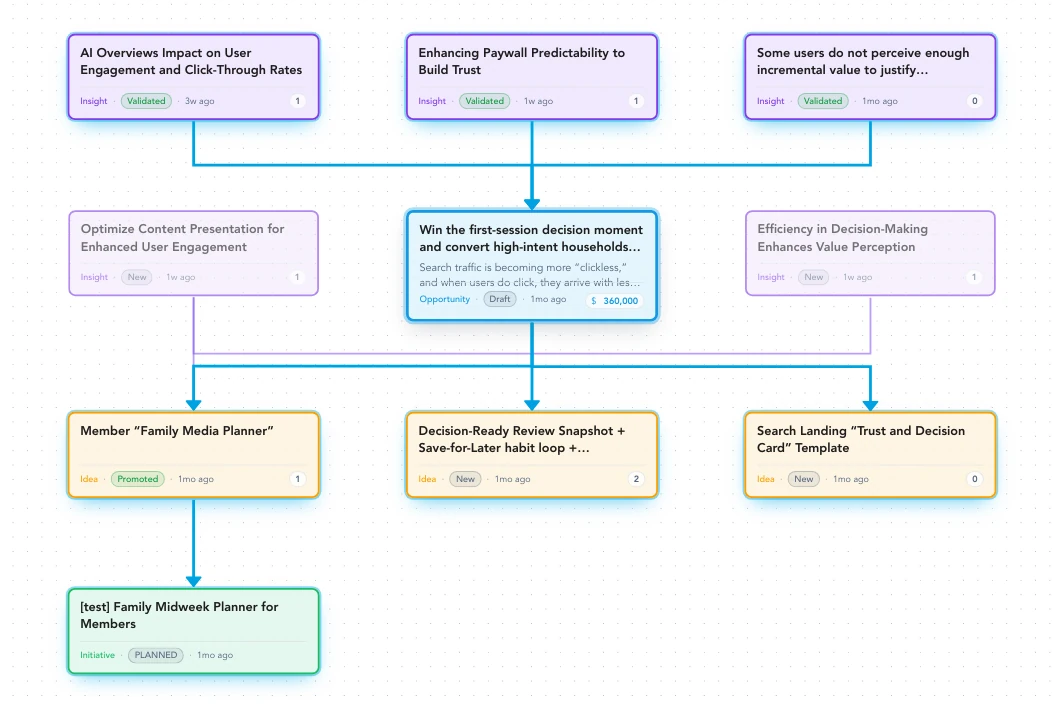
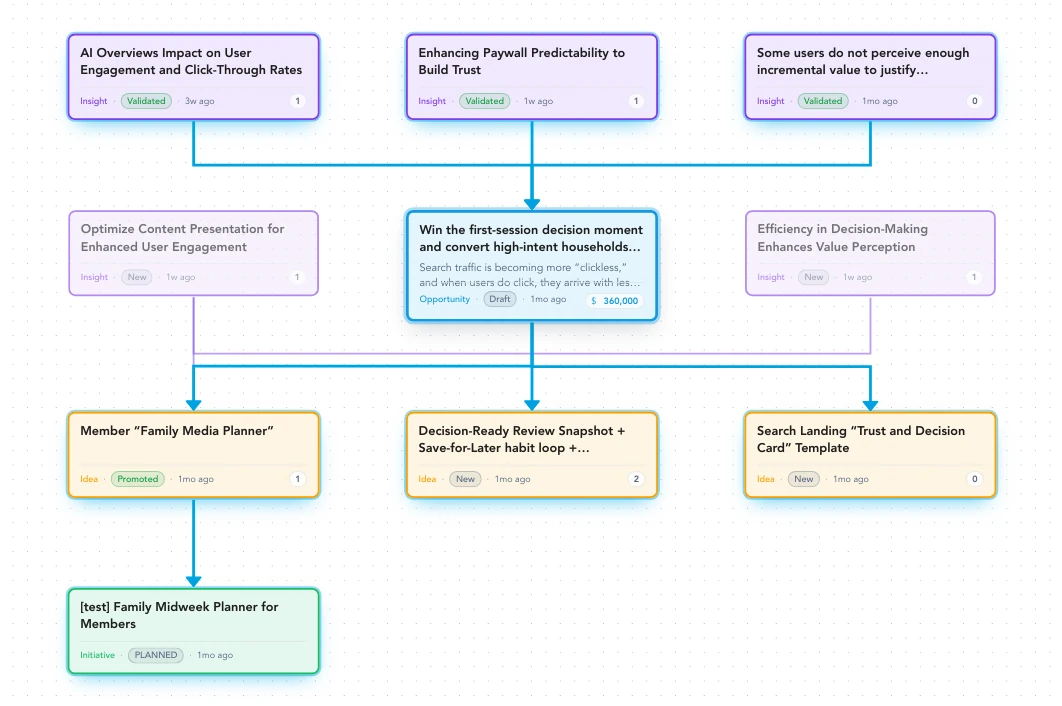
What that should look like in practice:
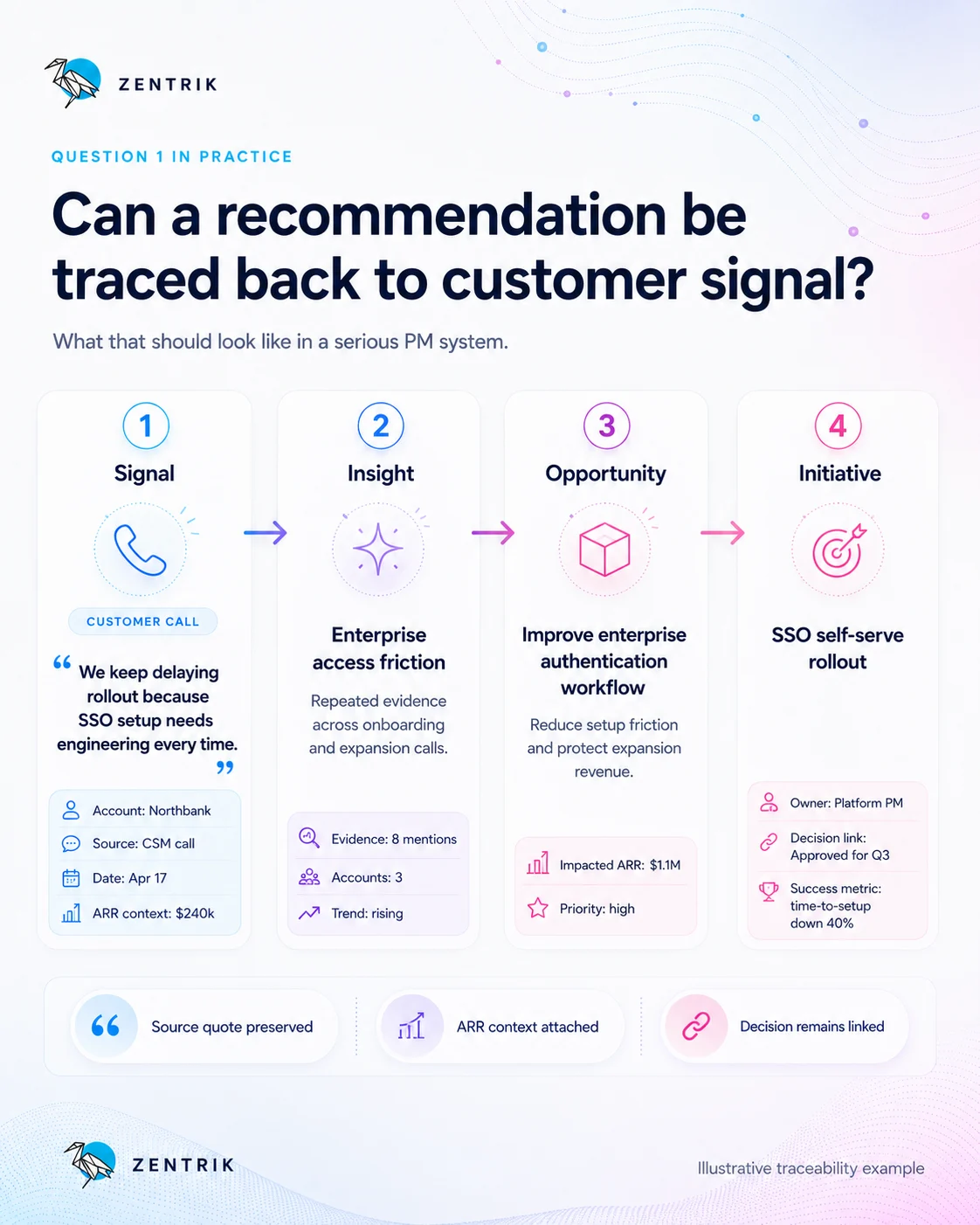
The image above is illustrative. The chain is real for the teams running Zentrik now: a CSM call gets parsed into a Signal node, the Signal aggregates with 7 similar mentions across 3 accounts into an Insight, the Insight rolls up into an Opportunity weighted by $1.1M of impacted ARR, and the Opportunity informs an Initiative that the Platform PM owns and that has a measurable outcome attached. Every node points back to the source. None of it requires the PM to rebuild the chain by hand.
That is what Q1 looks like when the answer is yes.
Question 2: Does the tool reflect how our team actually makes decisions?
Most PM tools assume your team works the way the tool's first 10 customers worked. Some teams do. Most teams do not.
The question underneath this one is whether the tool can model your decision rights, cross-functional rhythms, and planning process without forcing them into its preferred shape.
Good answer: the tool supports your operating model. Decision rights, role permissions, and cross-functional workflows are configurable, not forced. The system bends to your team.
Red flag: the tool forces a process that does not match how you work. The PM ends up "translating" between what the team actually does and what the tool wants to record. That translation is invisible labor; it is also the work the tool was supposed to remove.
A concrete way to ask: walk the vendor through one decision your team made last quarter. Name who weighed in, who decided, and what the trade-off was. Then ask where that decision would have lived from source to outcome. If the answer requires three workarounds and a custom field, the tool was built for someone else's company.
Question 3: Can we connect strategy to impact without rebuilding everything?
Roadmaps disconnected from outcomes are slides, not systems. A roadmap that needs a 6-month migration before it can connect to outcomes is still a slide with an implementation plan attached.
The question underneath: does the tool let your existing strategy artifacts, roadmap items, and outcomes connect together as your team learns, or does it want you to rebuild your taxonomy from scratch in its preferred shape before the value shows up?
Good answer: strategy, roadmap, and work items link to outcomes, and the links can evolve as your understanding evolves. You can add structure without throwing out what you already know.
Red flag: the roadmap is a presentation surface with no outcome layer underneath. Or the tool wants you to redo your taxonomy as a precondition for getting started. Either way, the tool's value is downstream of work the tool refuses to help with.
Switching costs are dropping because a modern system can read the records in your old tool. Make sure the product you are evaluating can ingest existing PM data and rebuild the connective tissue without a paid services engagement.
Question 4: Will this AI layer understand our product and our business?
Every PM tool has shipped an AI feature in the last eighteen months. The differences between them are mostly invisible from the marketing page.
The question underneath: when the AI generates a summary, draft, recommendation, or brief, does it understand your product, customers, and commercial constraints? Or is it producing the average answer to a generic question?
Good answer: the AI is grounded in your context. It respects permissions, it knows which accounts matter, it explains its reasoning, and it can tell you when it is unsure. The output reads like it was written by someone who has been at the company for a year.
Red flag: generic summaries that could have been generated for any team. Hallucinations dressed up as confidence. Black-box answers with no path back to the underlying data. The AI is impressive for thirty seconds and then becomes the thing the team turns off.
A concrete way to ask: bring 3 real signals into the demo, such as a Gong call, a Zendesk ticket, and a Confluence page. Ask the AI to draft an opportunity brief from them. Read the brief carefully. If you find one sentence the AI made up, you have your answer.
Question 5: What happens in month 6 when implementation gets real?
The person on your pitch call is almost never the person you talk to in month 6. That is normal. What matters is whether there is a sustainable team on the other side, and whether the company's structure will let that team do its job.
Good answer: clear plan for the first ninety days, real implementation support, and a product that keeps improving without surprise pricing changes. The CS team is named, scoped, and tenured.
Red flag: vague onboarding, a handoff to "customer success" with no specific person attached, or a vendor that has restructured 3 times in the last 2 years. Whether the product is good has stopped being the only question. Whether the team behind it can hold together long enough to serve you well has become part of the evaluation.
A concrete way to ask: how many CS people on your team in the ratio to accounts my size, who is the CS lead on my account, and how long has the average CS person on your team been at the company? The answers tell you more about your future with a vendor than any feature promise.
The questions do not tell you which tool to buy. They show you what you are buying.
How to use the rubric
Print it. Bring it into the next vendor call. Ask the questions in that order. Ask them of your incumbent first, because the incumbent's answers calibrate what realistic looks like across the rest of your shortlist.
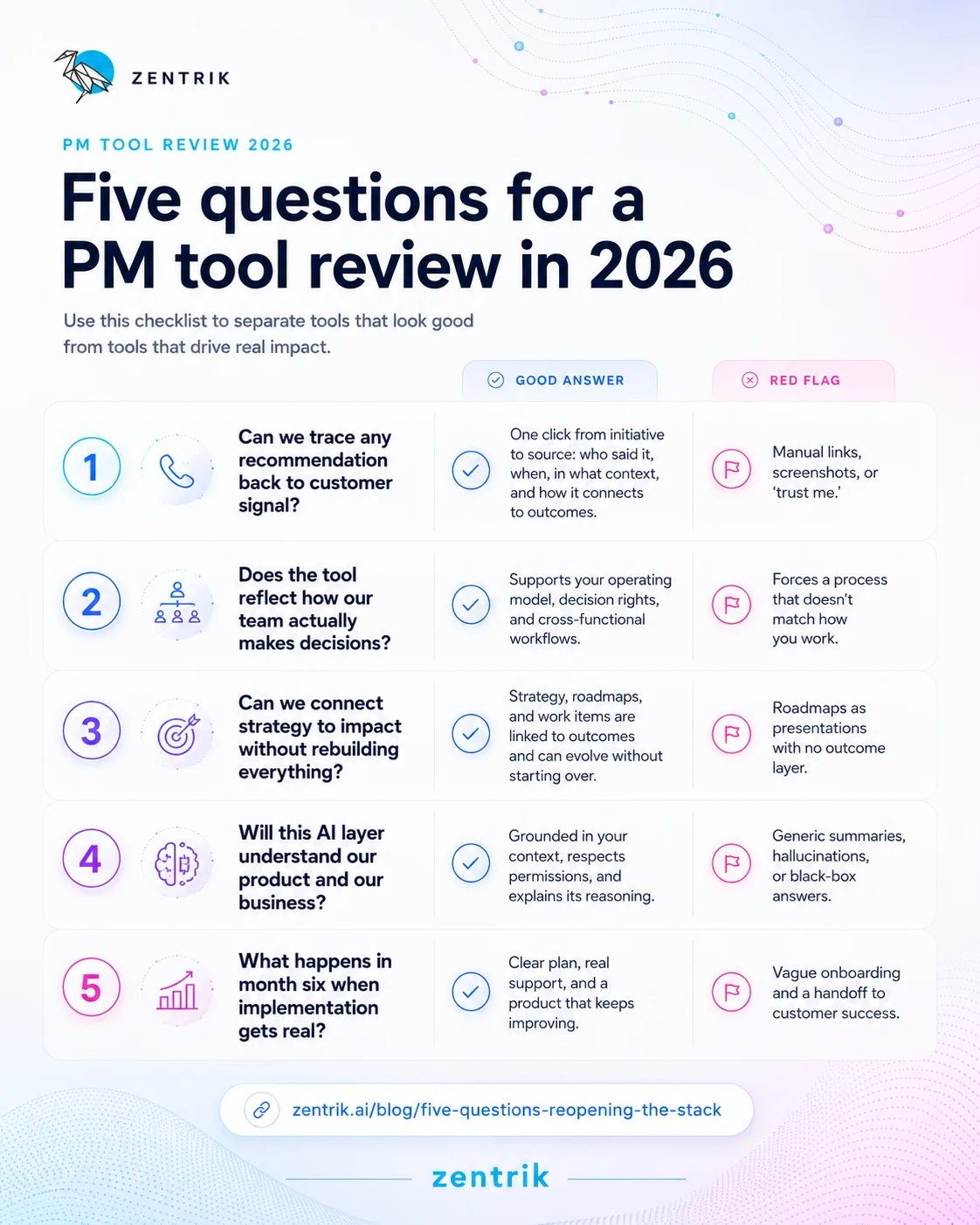
A team we work with used this rubric without naming it. They stayed with their incumbent for 12 more months, but renegotiated the contract after reviewing the architecture beneath the pitch. Another team used the same questions and decided to switch. Both choices fit the evidence they found.
The wrong call is not asking the questions.
A disclosure, because this rubric applies to us too
Zentrik starts with the source record. Its discovery graph keeps every recommendation traceable to specific customer signals, and its roadmap carries that evidence into the product decision. We built the AI layer around those records instead of grafting it onto an older workflow.
If you run these 5 questions on us, we believe we answer them honestly and well. We also believe we fall short in specific places that a 1-hour conversation with one of our pilot teams would surface, which is why we run those conversations openly rather than performing a demo on demo data.
The rubric is yours regardless. Use it on whoever is on your shortlist, including the tool you already pay for. The questions belong to your team, not to any vendor.
Use the rubric on whoever is on your shortlist. For the fuller argument behind it, continue with why the PM stack was built to store things and how to choose an MCP server by the record it carries.
Jab Co-founder, Zentrik