Why Flat Context Isn't Enough
Finding relevant files does not establish why a priority deserves attention. Keep the source, interpretation and decision connected, whatever storage you use.
Where intake starts
Insights only exist after signal lands from real channels. Everything downstream depends on this layer staying visible—not buried in slides.
Why flat context isn't enough
Finding related text is useful. The gap appears when a call, a code change and a strategy document arrive without the relationships or authority needed for the task. File-based systems can preserve those relationships; retrieval alone does not establish them.
Every product management tool promises insights.
Search any PM, BI, CRM, or analytics software site for the word "insights" and you'll find it in the hero section, the subheadline, and at least 3 feature descriptions. Sometimes the pricing page too, for good measure.
The word has been used so broadly that it barely means anything specific anymore. In practice, what most tools mean by "insights" is: summaries. The AI read your transcripts and produced bullet points. Themes were identified. A report was generated.
This is useful. Genuinely. It saves time compared to reading everything manually.
It also stops at the worst possible moment.
Because the hard part of product management isn't generating insights. It's deciding what to do with them. And that decision is where most organizations lose the thread.
Teams using AI tools or chat agents to analyze market input risk losing the thread between what customers said and what the product does.
Where summaries go to die
A report from some calls gets created. "Users report friction with the export flow." It has a source, maybe a quote, occasionally a link to one of the original recordings.
Then what?
The PM reads it. Adds it to their mental model. Maybe creates a ticket, attaches a version. Maybe mentions it in planning.
3 months later, an engineer asks "why are we building this export improvement?" and the PM gives the best answer they can from memory.
The 12 calls where customers described the friction. The ARR connected to those accounts. The specific scenarios where users abandoned the flow. None of that is attached to the decision anymore.
This is context decay. And it's structural, not personal. It happens because the pipeline from "customer said something" to "team decided to build something" has no connective tissue.
Most AI tools make this worse, not better. They generate more summaries faster. More content that also doesn't connect to decisions. The repo gets fuller. The decisions stay ungrounded.
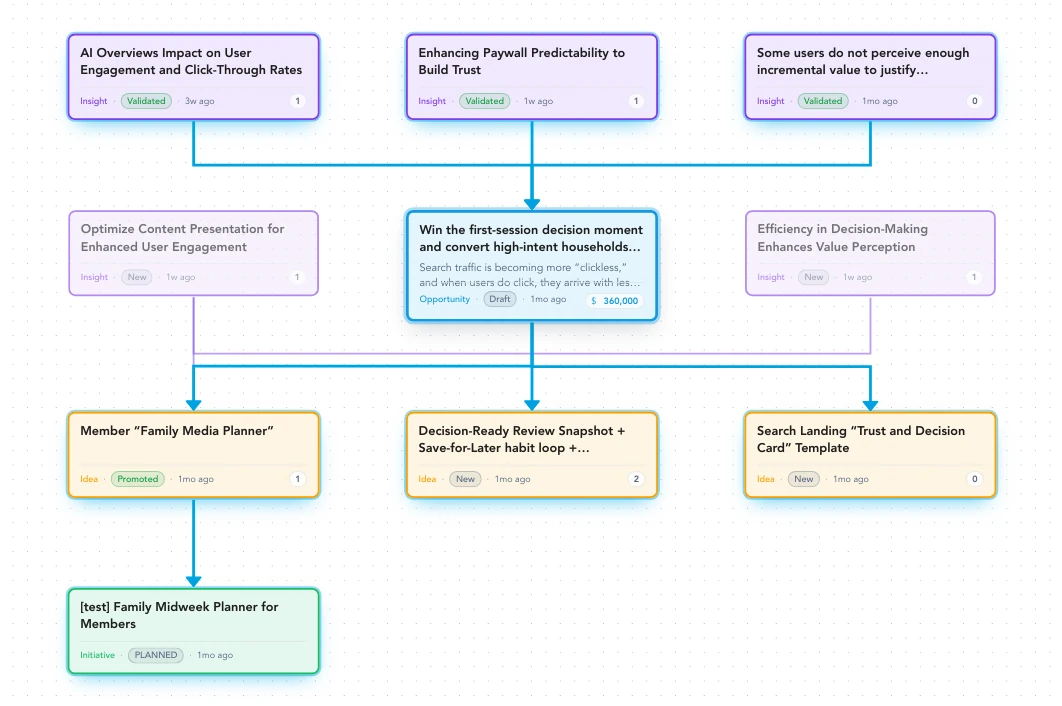
Useful product evidence is grounded on your context, converging into opportunities the team can defend, then branching into concrete ideas the roadmap can actually weigh.
When signals roll up into one legible opportunity, the roadmap conversation can stay grounded in what customers actually said and what revenue sits behind it.
What has to survive the planning meeting
Useful product evidence converges into an opportunity the team can defend, then branches into concrete ideas the roadmap can actually weigh.
Opportunity
Export reliability is now an executive-priority problem
The useful question is whether this is the bet to act on—not whether someone remembered the calls.
Sources
Insights
Opportunity
Opportunity
Export reliability is now an executive-priority problem
The useful question is whether this is the bet to act on—not whether someone remembered the calls.
Ideas
What traceability actually requires
Traceability means: when someone asks "why is this our priority?" the answer isn't "because we talked about it." The answer is visible. Here are the signals. Here's the ARR. Here's how this compares to the other opportunities we considered.
This requires explicit relationships: signals connected to insights, insights to opportunities, and opportunities to initiatives. We represent those relationships as a graph. They can also be recorded in linked files or other databases. The test is whether a reviewer can follow and challenge the connection, not which storage technology the team chose.
It also requires shareability. The traceability view is only useful if it can travel. A VP should be able to open a link and see the evidence chain without needing to log in to the PM tool and learn the interface.
ARR context can add a commercial perspective. Knowing that "5 customers mentioned this pain" is different from knowing that "5 customers representing $2.3M in ARR mentioned this pain." Revenue may change the tradeoff, but it does not establish that a claim is true or that the highest-revenue request is the right product choice. Keep source quality, segment fit and the severity of the problem visible too.
The fix starts with a different surface: shareable evidence briefs, ARR rollup in the traceability view, and a graph where the connection from signal to decision stays explicit.
That kind of surface does more than help with stakeholder communication. It lets teams audit their own thinking before engineering starts building. "This felt high-priority, but the signal is concentrated in one segment." That self-correction is where the real value lives.
One place for customer language, revenue weight, and why the priority moved, so nobody has to replay the story from memory.
With Zentrik, you can move from problem framing to a full trace in one flow: describe the bet, review evidence, and see how the story sits next to ideas you already have on your backlog.
Example: a shareable priority brief
Illustrative export-friction scenario—same shape you can produce when signals roll up into one opportunity with ARR on the line. Copy is fictional; structure is the point.
Priority brief
Export friction is blocking expansion
- Gong call · Acme Health$820k ARR
“Export breaks when our PMM team tries to hand reports to finance.”
- Zendesk ticket · Northstar$640k ARR
“We rebuild the export manually every month. It blocks renewal prep.”
- Confluence note · QBR prep$840k ARR
Expansion accounts keep flagging export trust as a procurement blocker.
About $2.3M ARR across 14 accounts, concentrated in expansion and renewal. Finance and PMM keep hitting the same wall: exports they cannot hand off cleanly for close and QBR prep.
Procurement keeps asking for proof we can support audited reporting handoffs. Northstar and Acme are not edge cases—the objection repeats in every expansion thread in this sample.
Confirm sequencing ahead of the onboarding backlog this quarter and align on customer comms if we deprioritize manual spreadsheet exports.
If you want this in your org
Create a workspace at zentrik.ai/register.
-
Connect your sources (Gong, Zendesk, Jira, Aha!…), or use the API.
-
Signals and ideas will be processed automatically.
-
Describe the bet, opportunity, or problem you're exploring.
-
Get a complete tree with nuggets from evidence and backlog threaded around your current priority.
-
(Optional) Bring your taxonomy (AI-enabled custom fields) to look at your learnings and backlog from any angle.
Prefer a walkthrough first? Tell us what you use today at zentrik.ai/contact. We will help you map sources and run a real cycle on your data.
Coding agents: When your workspace uses the graph as the source of truth, tools that use MCP can operate with the same structured context your team has. Start at zentrik.ai/docs/integrations to see how it all fits together.
For direct Zentrik to Cursor integrations see Cursor + Zentrik.
Product guide: Step-by-step context for opportunities and this narrative flow lives under Discovery: insights → opportunities.
For the broader stack-level argument, read The PM Stack Was Built to Store Things.
Evidence traceability
Follow the evidence trail
Subscribe for the next field note on evidence, decisions, and agentic product work.