The PM Stack Was Built to Store Things
The work has changed. PM tools built to store artifacts are being asked to act on decisions before the signal goes stale.

Context in motion
Signal
Calls + research
Decision
Approved intent
Guardrail
Non-goals
Zentrik
Context compiled with evidence and constraints
Cursor
Builder plan
Jira
Synced scope
Claude
Sourced answer
The dominant PM tools of the last decade were designed to solve a specific problem: product managers had feedback, features, insights, specs, and decisions scattered across a dozen places, and they needed a single place to put all of it.
That was a real problem. The tools that solved it won.
But the problem has changed. It's no longer "I have no place to store my work." It's "I spend most of my week moving my work between places, sorting it, tagging it, and watching the signal go stale before I can act on it."
We've interviewed hundreds of product managers over the last 3 years. The complaint has shifted from "I don't have a system" to "I am the system." The tool is fine. The tool is also the job, and the job is administrative.
The translation tax
The PM becomes the translation layer.
Signal arrives continuously. Decisions still have to leave as one coherent story.
PM as translation layer
Manual synthesis, context loss, evidence detached, summary of a summary.
Meanwhile, the market around PMs has accelerated. Roadmaps have to respond faster. Customer signal is louder and more multi-channel. The person asking "what should we build next?" is under more pressure from their CEO than at any point in the last 5 years. The tool that was supposed to make that person faster is, in most cases, turning them into a librarian.
This is the category shift. And a tool built for the old shape can't be retrofitted into the new one.
The Retrofit Trap
Every major tool in the PM category has shipped an "AI" release in the last 18 months. New panel. New chat. New summarization button. New pricing tier with "AI" in the name.
If you're evaluating any of them, you already know the feeling. The AI is impressive for 30 seconds, and then it gets stuck because it doesn't understand the shape of your actual product, your actual customers, or the decisions your team has made before. It can summarize a page. It can't run a prioritization conversation.
That gap is not a prompt problem. It's an architecture problem.
A tool built as a system of record treats every insight, every feature, every customer signal as a row in a table. AI on top of a table can query the table. It can't reason across the connective tissue between rows, the why behind the roadmap, the trade-off that was considered and rejected 6 months ago, the customer who churned because of the deprioritized thing in Q2. That tissue doesn't exist in the schema. And you cannot retrofit a schema.
A tool built as a system of action treats decisions as the primitive. Not features. Decisions. The tool knows what you're trying to figure out, what evidence supports it, what evidence is missing, and who can give it to you. AI in that world isn't a button. It's the orchestration layer that turns intent into motion.
"We added AI" and "we were built around AI" are not versions of the same product.
That is the takeaway. Buyers who miss that distinction pay for the difference later.
Why It Matters Now
3 things have shifted at the same time.
- The people inside your PM tool have less time. Every product org I talk to is being asked to ship more with fewer headcount. The administrative tax on a PM's day has gone from annoying to existential.
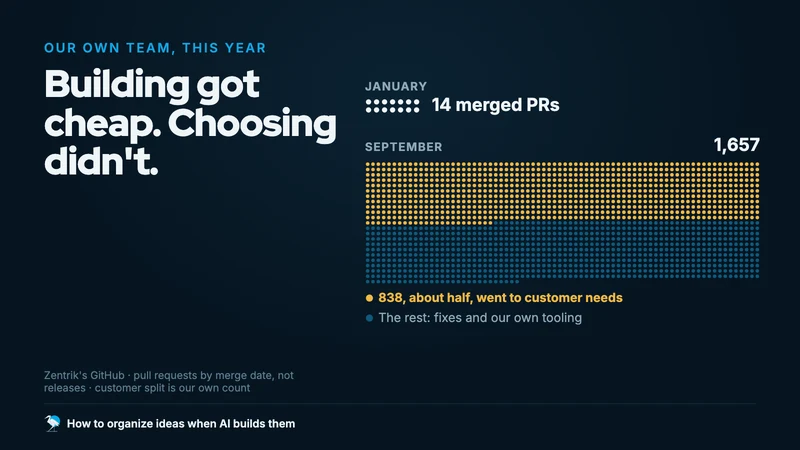
- The evidence going into the tool has multiplied. Between call recordings, support tickets, sales feedback, Pendo and Mixpanel data, NPS, and the Slack channels where customer quotes actually live, the signal a PM has to sort through is roughly 10× what it was 5 years ago.
- The decision velocity has increased. What used to be a quarterly planning cycle is now monthly, and in some orgs weekly.
The old architecture buckles under these 3 pressures simultaneously. No new AI tab can redistribute that load.
What a System of Action Looks Like in Practice
Concretely, the new shape does a few things the old one cannot.
- It ingests signal continuously from the places PMs already work, like Gong, Zendesk, Salesforce, Pendo, and the existing roadmap tool, rather than asking PMs to paste into it. The tool comes to the work. The practical version starts with connecting the sources where product signal already lives.
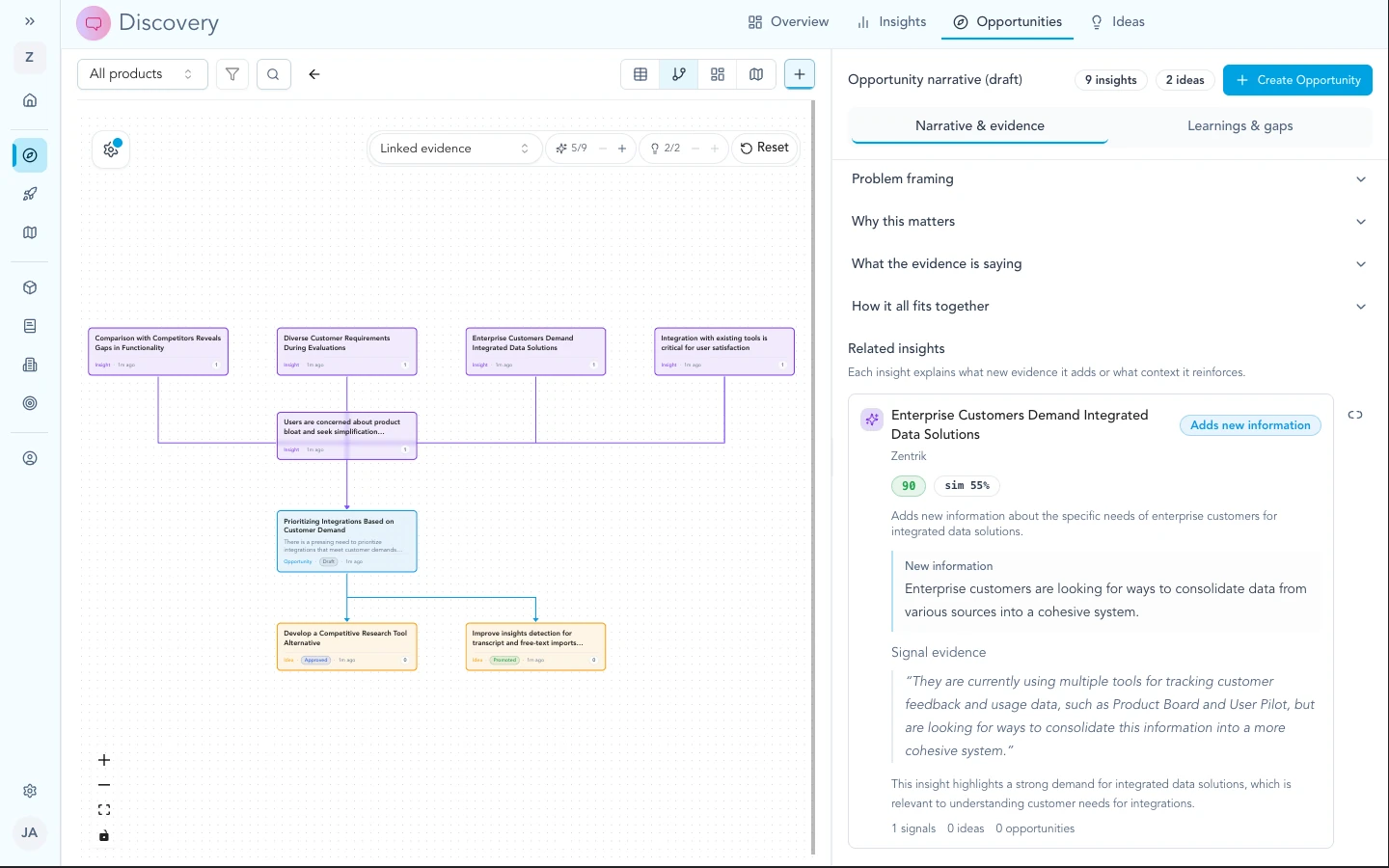
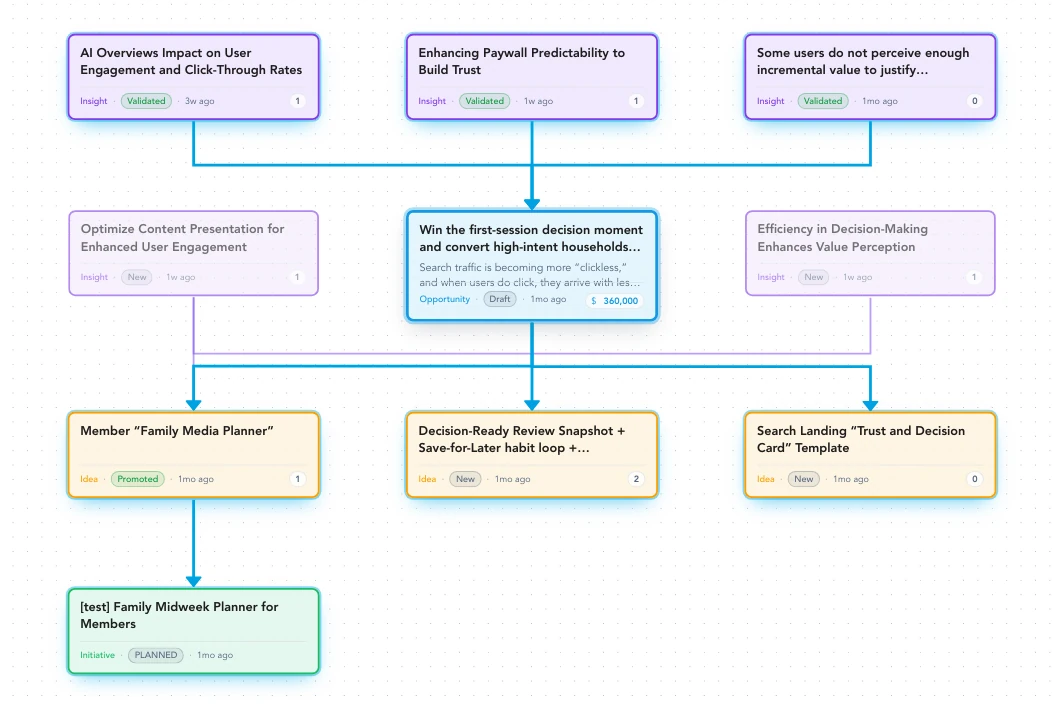
- It organizes signal by the decisions it informs, not by the feature bucket it sits in. Two pieces of evidence that point to the same decision but live in different product areas show up together, not in separate views.
- It drafts opportunity trees, briefs, and prioritization documents as living artifacts based on the evidence it's seen. The PM edits instead of starting from blank.
- It holds the context across cycles. When someone asks "why didn't we do this thing?" in November, the tool can tell you what you decided in March and what evidence informed it.
- It lets AI agents do the janitorial work, tagging, linking, deduplicating, summarizing, so the PM's week goes to the work an agent cannot do. That same structured context can then feed AI builders with product intent attached.
Teams use this workflow in Zentrik Discovery. For the deeper version of why summaries alone do not solve it, start with Why Flat Context Isn't Enough. For the signal-volume story, read What Was in the Other 1,800 Calls.
The Switch Is Lower-Cost Than It Looks
The biggest blocker to switching PM tools is rarely skepticism about the new tool. It is dread of the migration. "We have 4,000 feedback items, 200 features, 3 years of context in the current system. We can't move."
That reasoning was true in 2022. It is not true in 2026, and for exactly the reason this essay is about. A modern system of action can ingest your existing PM data, the feedback, the features, the opportunity trees, the customer quotes, and reconstitute the context on the other side automatically. The tool reads your old tool.
What used to feel like a six-month migration can now look like a couple of weeks.
This is the quiet consequence of the category shift that most buyers haven't priced in yet: the switching cost in this category is dropping, fast. The teams that move first get the compounding advantage of being built on the new architecture while everyone else is still paying the retrofit tax.
How to Evaluate in the New World
If you're reviewing your PM stack this quarter, here is the reasoning sequence I would run. Each one takes 10 minutes in a vendor call. None of them appear on the comparison grid.
- Storage or action? Pull the AI out of the demo and ask: is the product still coherent without it? If yes, the AI is a panel. If no, the AI is the product.
- Features or decisions? Ask to see one decision, end to end. A feature-centric tool will walk you to a feature page. A decision-centric tool will walk you through a flow.
- Native or retrofit? Was this product built before 2023 and bolted onto AI later, or built around the new shape from day one? Both can work. Know which one you are buying.
- Year 2 over year 1. Year 1 ROI is the demo. Year 2 ROI is whether the tool has compounded on your team's input. If it has not, you are renting a repository with a chat window.
- Hours removed, not hours faster. The new tool should take hours off the PM's calendar, not just reshape them. Ask the vendor what their last 3 customers actually saw.
A vendor who cannot answer those 5 in plain language has given you your answer.
The point is not that every team should replace its PM stack tomorrow. The point is that the evaluation criteria changed. When execution gets cheaper and faster, the expensive part becomes the quality, freshness, and portability of product intent.
That is the thread across this series. The bottleneck moved upstream. Flat context was not enough. The other 1,800 calls were never empty; they were just outside the decision system. This essay is the stack-level implication: the next PM tool category will not be won by storing more artifacts. It will be won by helping teams turn signal into decisions that can move.
If you are reviewing your PM stack this quarter, the useful question is not "which product has AI?" It is: "which product changes what the PM no longer has to carry?"
That is the question worth taking into the vendor call.
For the product-level version of this argument, see how Zentrik moves product teams from a system of record to a system of action.
If your team is reopening that question, bring one real decision and its source records to zentrik.ai/contact. We can inspect the handoff together before discussing a migration.
Jorge