How to organize ideas when AI builds them
When agents make building cheap, the order of your backlog decides what ships. Five ways teams sort ideas (a list, votes, a scorecard, an opportunity tree and evidence), what each one sorts by, and what happens to each when output explodes.
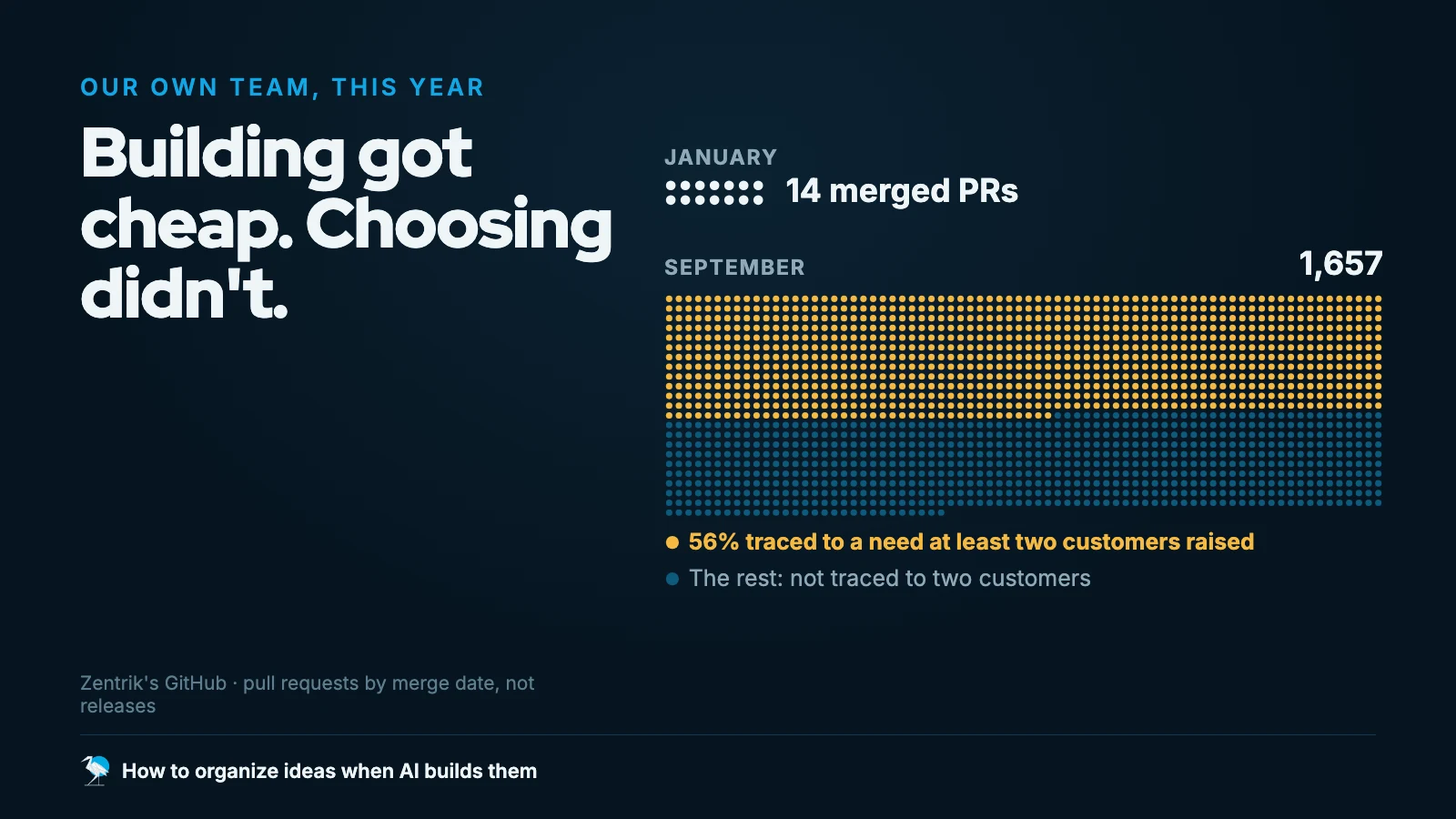
In January, Pablo and I merged 14 pull requests. In September, working with agents, the same two of us merged 1,657. October reached 1,050 by day 18.
When building is this cheap, the order of the backlog decides what ships. In September, 56% of the pull requests we merged traced to a need at least two customers raised. The rest didn't. We started counting that in January, at zero. Speed doesn't tell you which half you're in. The way your backlog is sorted does. (The longer story is in part one.)
So here are the five ways I see teams sort ideas, what each one actually sorts by, and what happens to each when output explodes. The ideas, votes and scores in the figures are illustrative.
1. A list sorts by who asked last
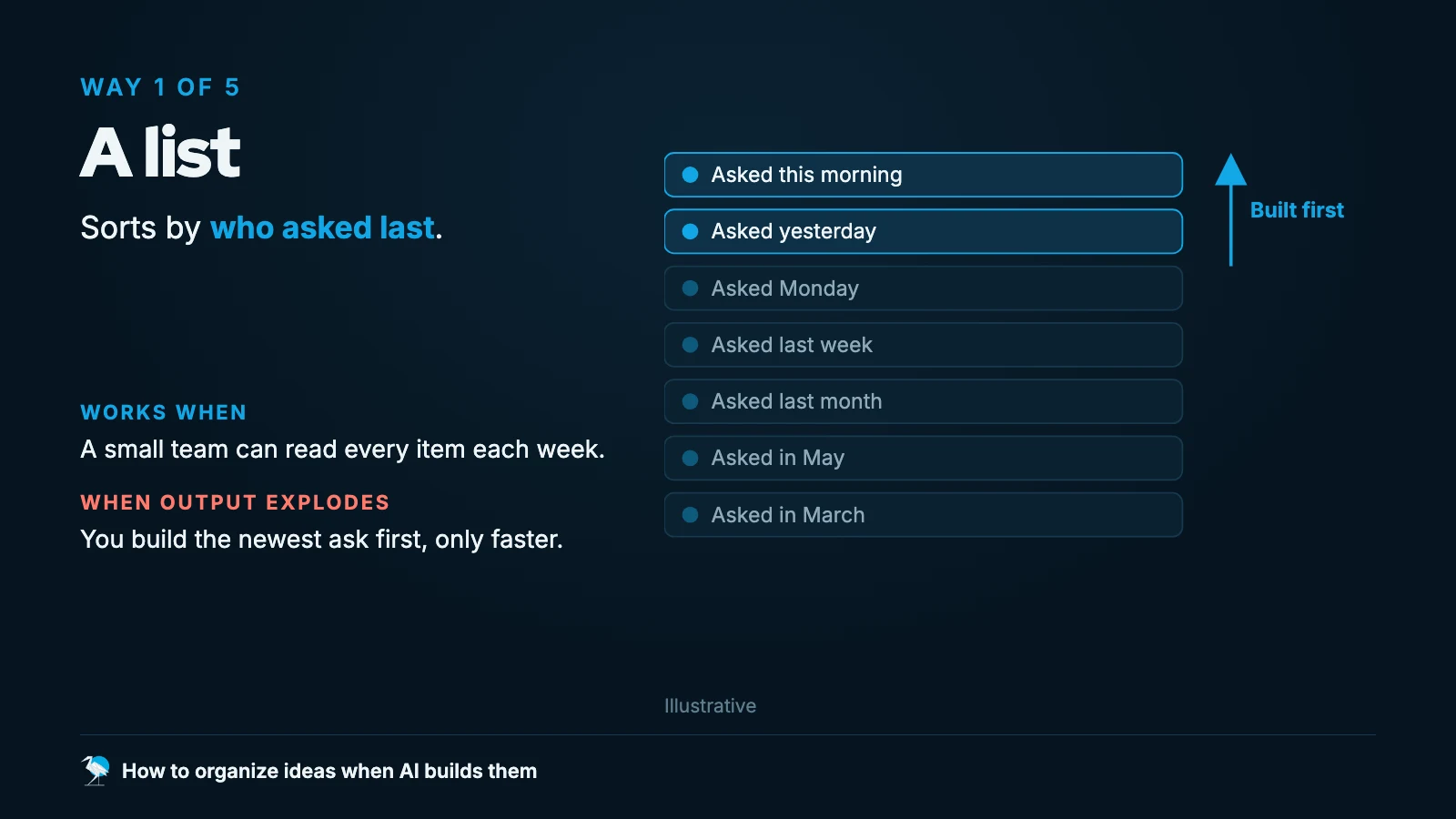
Most backlogs start as a list. New requests go on top, and the top gets built. That works when a small team can read every item each week. When output explodes, you build the newest ask first, only faster. The list never says who asked or what they're worth.
2. Votes sort by how many asked
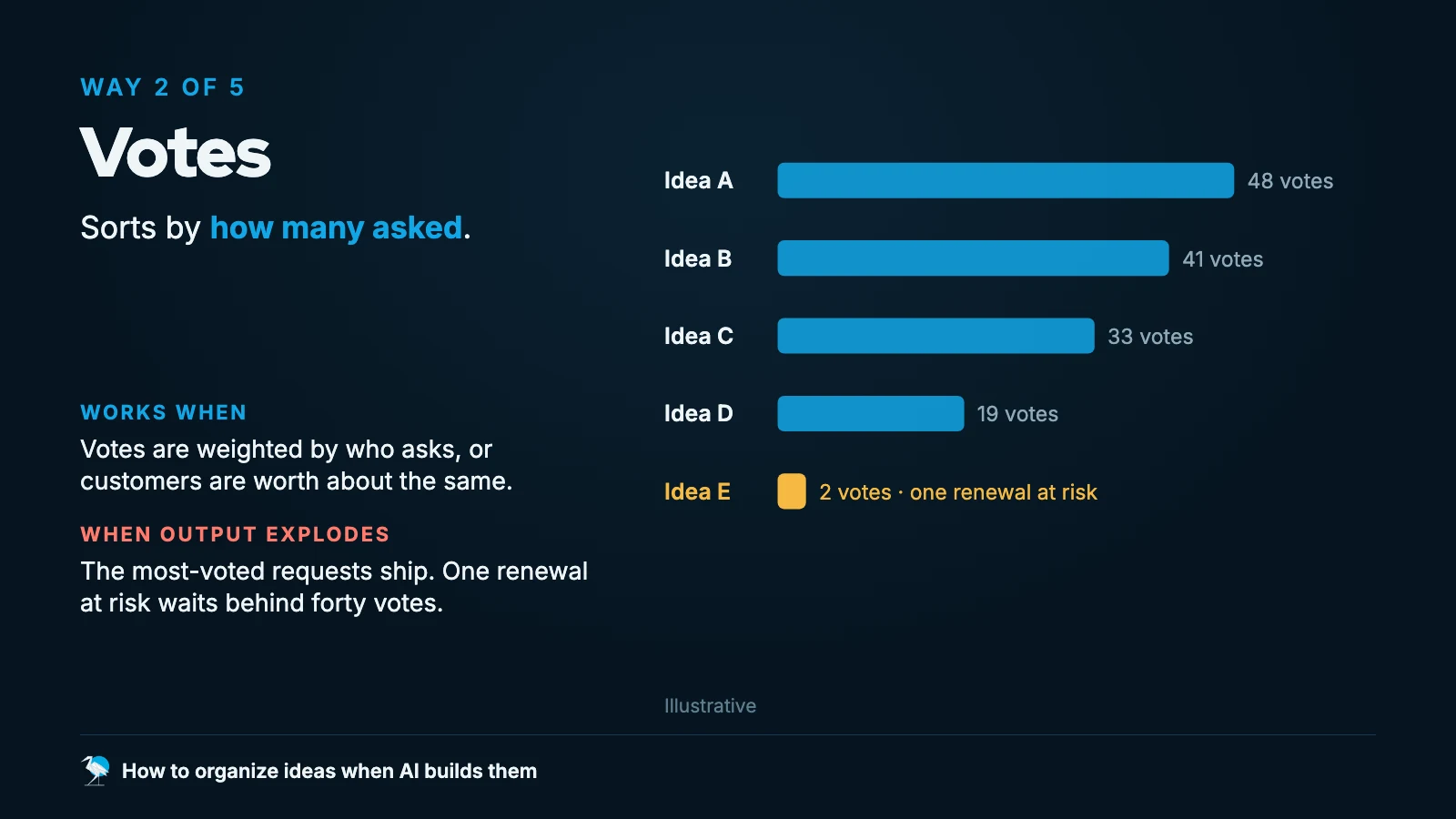
A voting board counts requests. Productboard and others can weight votes by segment or revenue, and that helps. If yours isn't set up that way, the most-voted requests ship, and a renewal at risk with two votes waits behind ideas with forty. More capacity ships those sooner.
3. A scorecard sorts by how someone scored it
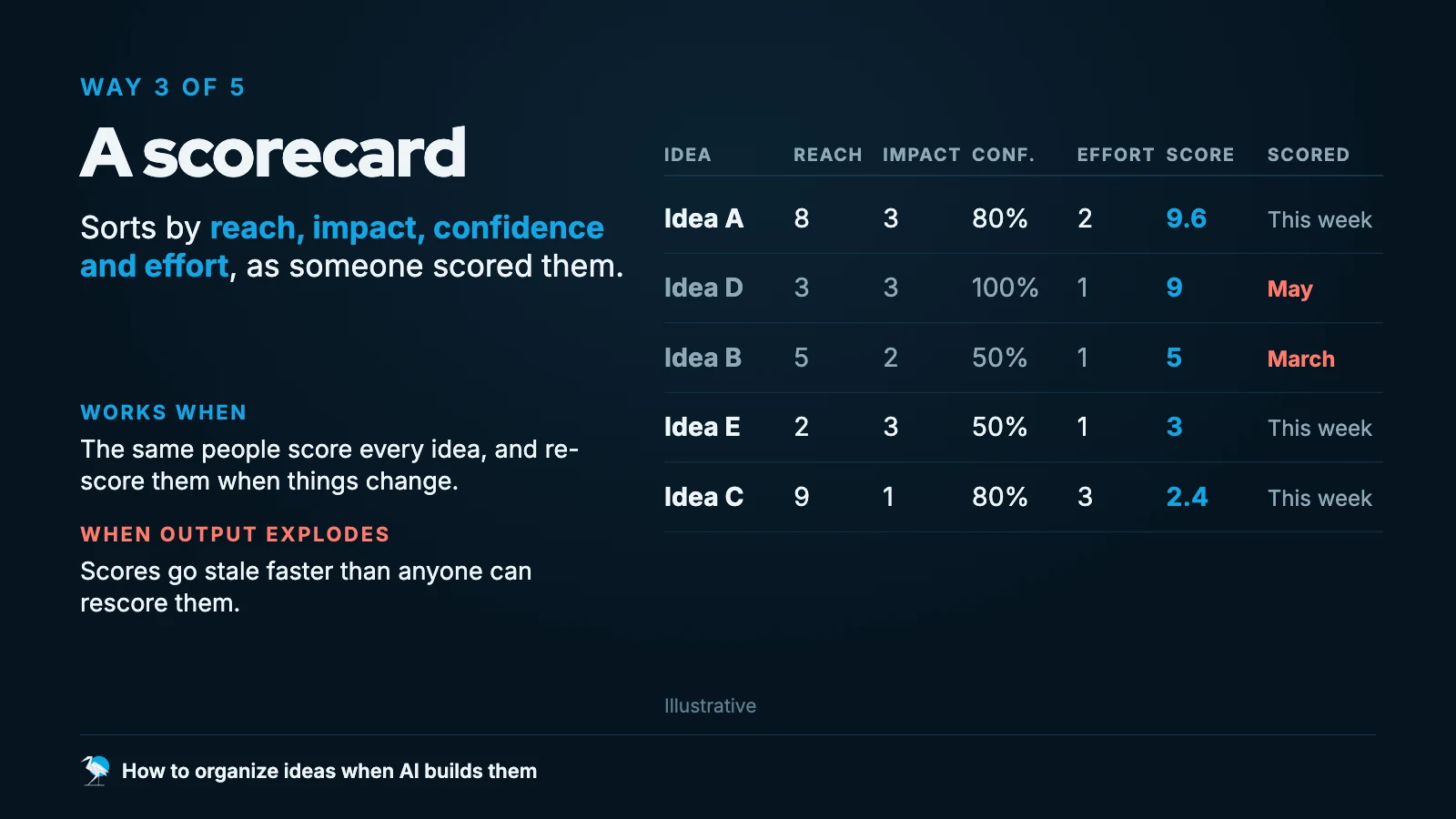
Intercom's RICE score (reach × impact × confidence ÷ effort) and cousins like ICE put a number on every idea. Nothing stops you from putting revenue into reach. The catch is time: the number is only as fresh as the last time someone scored it. In the example, Idea D still ranks second on a score from May. When a team ships fifty changes a day, the facts behind those scores move faster than anyone can rescore them.
4. An opportunity tree sorts by the outcome each idea serves
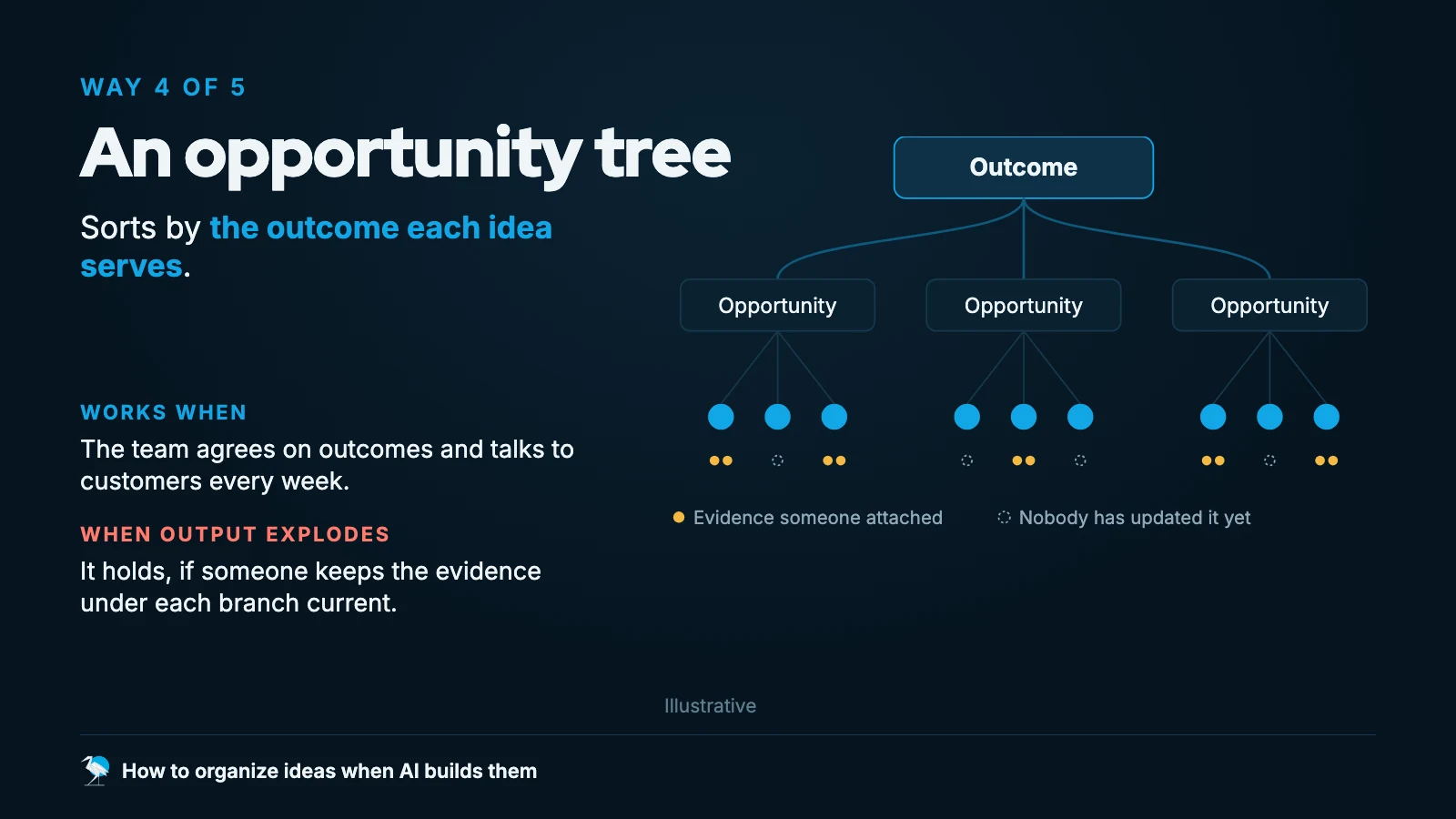
Teresa Torres' opportunity solution tree ties each idea to the outcome it serves, which is the right question to ask. It holds up when output explodes, as long as someone keeps the evidence under each branch current. The tree shows you where evidence is missing. It doesn't go and get it.
5. Evidence sorts by the calls, tickets and revenue behind each idea
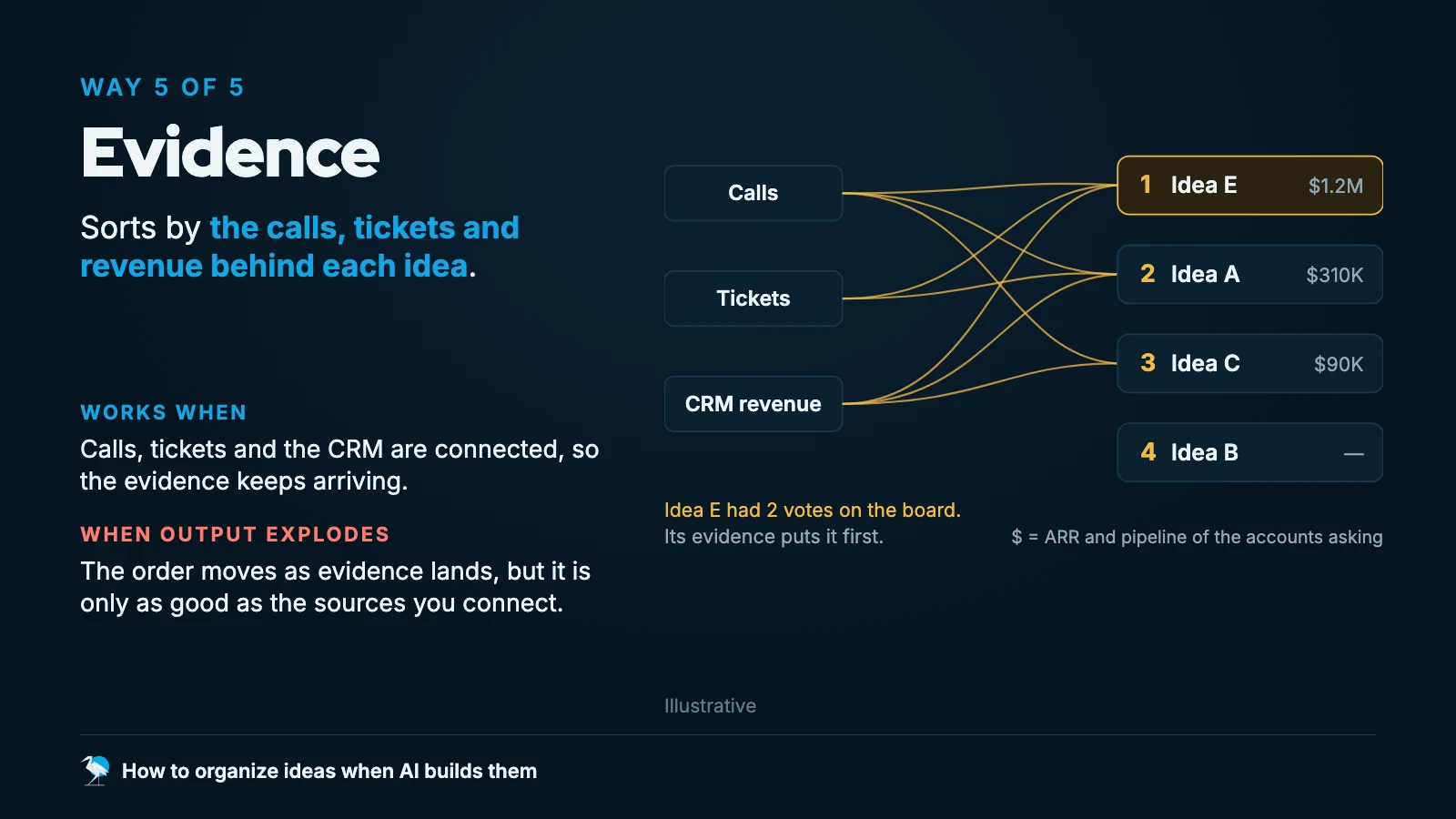
The fifth way ranks ideas by what customers said and what they're worth: the calls and tickets that raise a need, and the ARR and pipeline of the accounts asking. In the example, Idea E had 2 votes on the board, but three sources and $1.2M sit behind it, so it goes first. Idea B, the second most-voted, has nothing behind it yet. The order moves when new evidence lands, so it keeps up with output. Its limits are plain. It's only as good as the sources you connect, and it tells you who needs something and what it's worth, not what it costs to build. Pair it with an effort estimate and the outcome you're after.
Prioritization methods compared: a list, votes, RICE, an opportunity tree and evidence
| Way | Sorts by | Works when | When output explodes |
|---|---|---|---|
| A list | Who asked last | A small team reads every item each week | The newest ask ships first |
| Votes | How many asked | Votes are weighted, or customers are worth about the same | The most-voted requests ship |
| A scorecard (RICE) | Reach, impact, confidence, effort | The same people rescore when things change | Scores go stale |
| An opportunity tree | The outcome each idea serves | The team agrees on outcomes and talks to customers weekly | Holds, if someone keeps the evidence current |
| Evidence | Calls, tickets and revenue | Calls, tickets and the CRM are connected | Keeps up, and is only as good as its sources |
Most teams mix these. A tree with live evidence under every branch is a good place to end up.
Three checks for your backlog
- Pick any idea near the top. Can you see who asked for it, and what those accounts are worth?
- Add one new call or ticket. Does the order change?
- Rank ten decisions you already made. Did the winners land on top? Here is how I'd run that test.
If two of those come back no, your backlog is sorted by something other than what your customers need, and faster building will ship that order faster.
Where Zentrik fits
Zentrik, an alternative to Productboard and Aha! built for the fifth way, ranks the ideas you already have by the evidence in your calls, tickets and CRM, and the revenue behind each one. It starts from the backlog you have, with Aha! and Jira Product Discovery imports included, and you approve the order. If you're weighing tools, here is how Zentrik compares with Productboard, Aha!, Jira Product Discovery and others.
Field notes
Get the next field note
Practical notes on building with customers in the loop while agents do more of the building.