Introducing Zentrik Loops
AI made building faster. Product teams now need product intent loops that keep customer evidence, human judgment, and agent-assisted delivery connected.
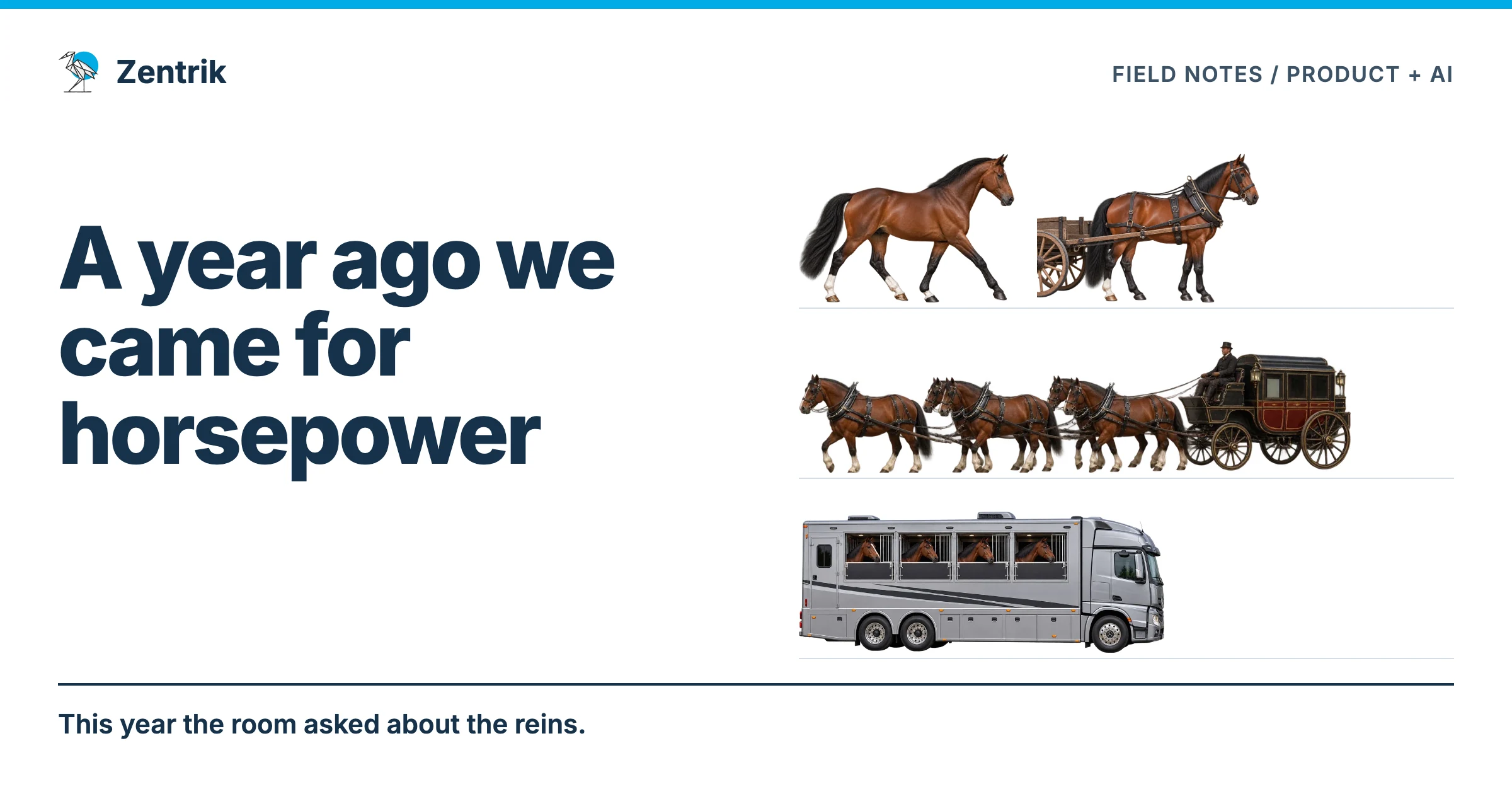
AI did not remove the product bottleneck. It moved it.
Building is faster. Specs are faster. Prototypes are faster. A PM can ask an agent for a first pass at a brief, a designer can turn a prompt into a screen, and an engineer can move from ticket to pull request with more help than they had a year ago.
That changes the shape of product work, but not in the way the loudest AI conversation suggests.
The fragile part is no longer whether the team can produce an artifact. The fragile part is whether the artifact still carries the customer evidence, business constraint, product intent, and human judgment that made it worth producing.
Most teams do not lose product quality in one dramatic moment. They lose it in handoffs.
A customer call becomes a summary. The summary becomes a roadmap line. The roadmap line becomes a spec. The spec becomes tickets. The tickets become agent work. By the time the work reaches delivery, the original reason is thinner than anyone wants to admit.
Everyone did their job. The context still disappeared.
The tool market has noticed. This year nearly every product platform grew an agent, and the pitch is broadly the same: it knows your product, your customers, and your market, and it will do in minutes what used to take days. Some of these agents are genuinely useful. But watch where their work goes. A synthesis that arrives as a chat thread, a digest that lands in a channel, a brief generated into a document: each one is a new artifact that starts losing its context the moment it is created. The output got faster. The handoff problem got bigger.
That is the problem we are building Zentrik around.
We call the system Zentrik Loops.
The loop
The simplest way to describe Zentrik Loops is as a product intent loop:
Signal -> Intent -> Review -> Build -> Learn -> Signal
It is not a document factory, a PM chatbot, or an autonomous roadmap machine. It is a loop that keeps product intent inspectable as work moves.
Each step has a job.
Signal is where customer and market evidence enters: calls, tickets, CRM notes, public feedback, internal docs, usage patterns, and the product team's own observations.
Intent is where the team decides what the signal means. The useful output is not only an insight. It is a decision object: what problem is worth solving, which customers are affected, what constraints matter, and what success would look like.
Review is the human gate. AI can cluster, draft, summarize, compare, and propose. Product leadership still owns the call. The system should make review easier and sharper, not optional.
Build is where the decision becomes a brief, prototype, ticket, experiment, or agent task. This is where faster delivery helps, but only if the intent travels with the work.
Learn is where shipped behavior, customer response, support friction, sales feedback, and usage changes flow back into the product graph.
Then the loop starts again with better signal.
The receipt is the product object
The practical object in this loop is the receipt.
Before AI-assisted product work changes a roadmap, creates a ticket, updates a spec, or hands work to an agent, the team should be able to inspect a small set of fields:
- objective,
- source evidence,
- affected customer or segment,
- business or revenue context when relevant,
- constraints,
- decision owner,
- success criteria,
- review gate,
- downstream work,
- learning trigger.
Filled in, it is small enough to read in a minute. Imagine the bet is a self-serve onboarding revamp:
- Objective: cut time-to-first-value for new mid-market workspaces.
- Source evidence: 14 support tickets, 4 onboarding calls, and 2 churn post-mortems pointing at the same drop-off step.
- Affected customers: self-serve mid-market signups; 2 accounts already in renewal conversations.
- Business context: those 2 accounts carry $180k in renewal ARR; the theme spans a wider segment.
- Constraints: no changes to the pricing flow this quarter; reuse existing activation events.
- Decision owner: the growth PM.
- Success criteria: first-session activation moves, and the drop-off step stops appearing in new tickets.
- Review gate: product lead approves scope before tickets are created.
- Downstream work: 1 initiative, 6 tickets, 1 experiment.
- Learning trigger: 30 days of post-ship activation data, or 3 new tickets naming the same step.
None of those lines is hard to write. What is hard is having them in one place, still connected to the sources, when the roadmap question arrives.
If those fields are missing, the artifact may still be useful. It is not ready to carry product authority.
That distinction matters. A polished spec can be wrong. A confident summary can hide a weak source mix. A good prototype can prove only that a UI can exist, not that the problem deserves investment.
The receipt gives the team a way to ask better questions before speed compounds the mistake.
What customer evidence is this attached to? Who reviewed the interpretation? What did we choose not to do? What constraint should an agent respect? What would make us stop?
Those are not bureaucratic questions. They are the questions that keep product judgment visible.
Why this has to be a system
Teams have always wanted better product decisions. The difference now is that the downstream work can move before the upstream reasoning has settled.
When delivery was slower, weak intent had friction. It took time to write the spec, align the team, break work down, and get engineering capacity. That delay was not a good decision system, but it gave people more chances to notice a problem.
AI removes some of that delay. That is useful. It also removes some accidental protection.
If a product team can move from fuzzy idea to prototype, spec, tickets, and code in a day, then the evidence and review layer cannot live in someone's memory. It has to live in the workflow.
It also cannot live in a chat history. An answer in a thread is context on a timer: correct today, unfindable next month, absent from the next decision that needed it. A product system earns trust when its answers land somewhere durable, linked to the evidence that produced them, so the team never pays to regenerate what it already knew.
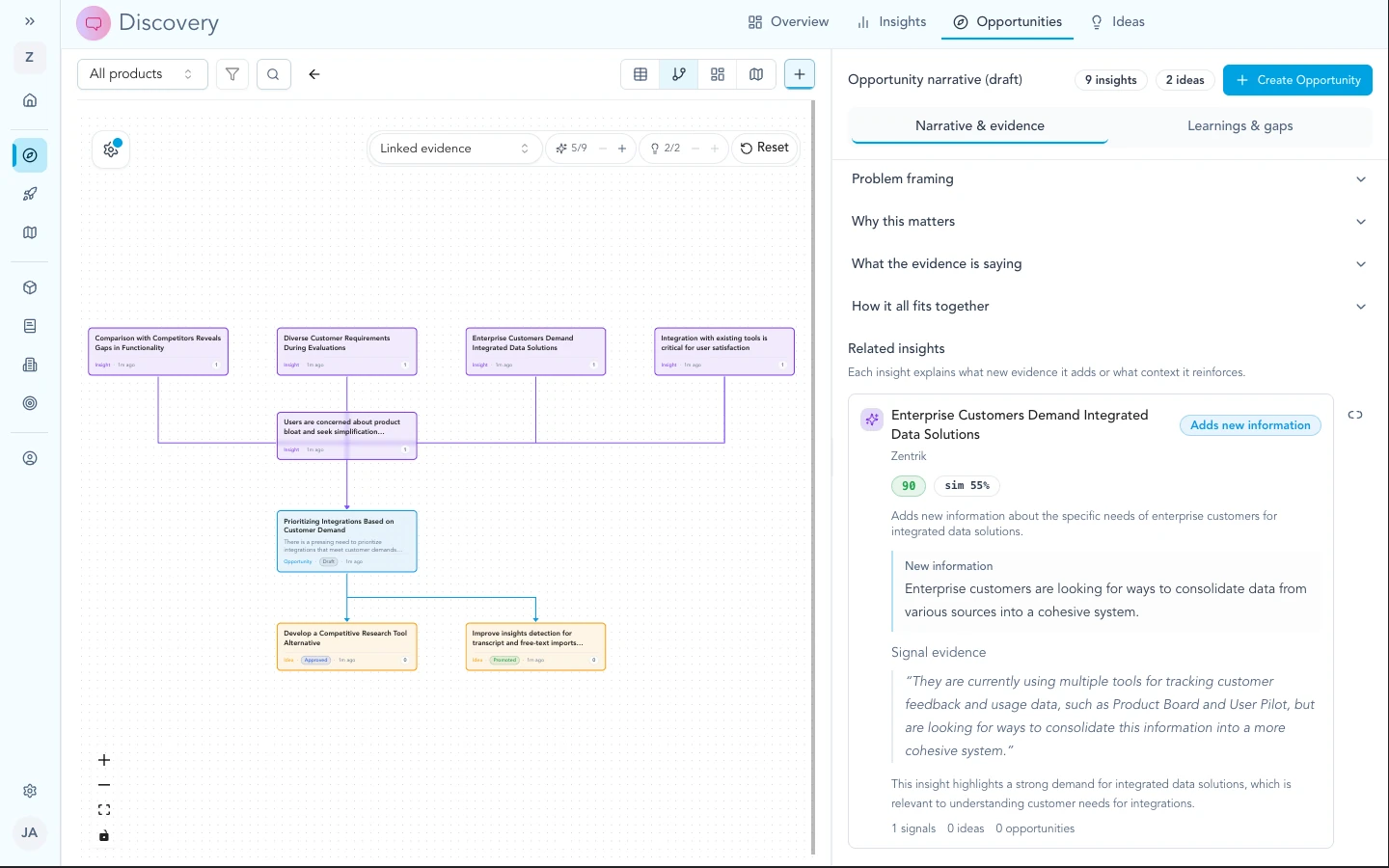
That is why we talk about a product graph.
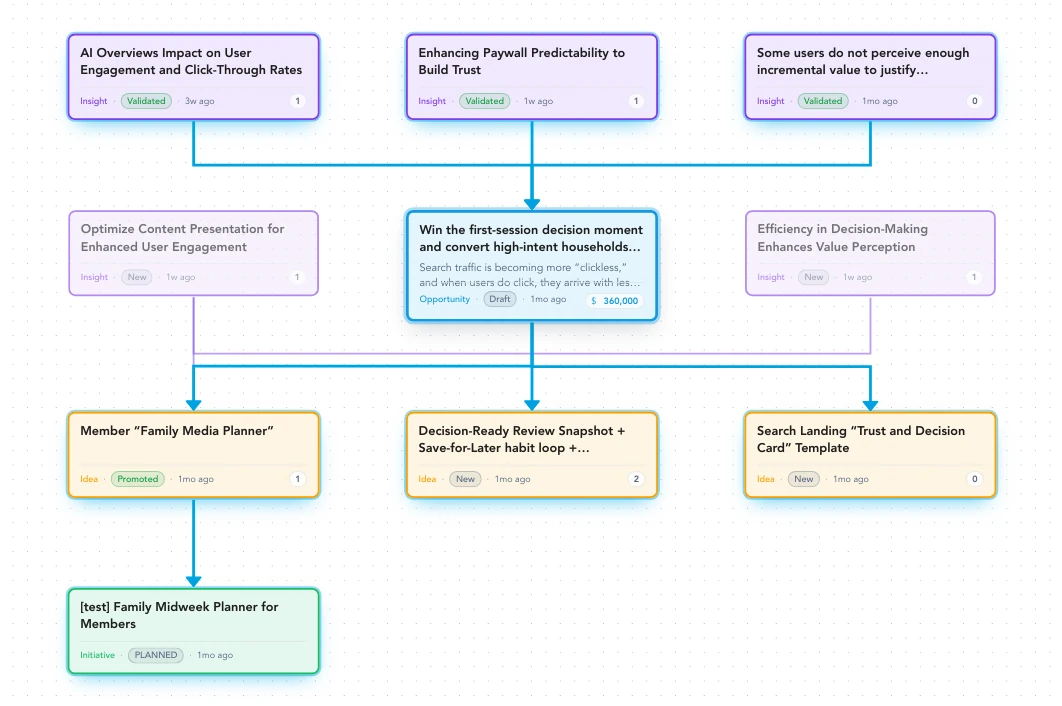
A graph lets the system preserve relationships that a document flattens:
- this customer signal supports this insight,
- this insight contributes to this opportunity,
- this opportunity competes with these alternatives,
- this decision produced this initiative,
- this initiative created these specs and tickets,
- this shipped work changed these signals.
The value is not the graph as a technical noun. The value is that a product leader can ask "why are we building this?" and get an answer that does not depend on the PM rebuilding the story by hand.
What agents need from product teams
Coding agents do not only need code context. They need product context.
An agent can read a repository and produce plausible work. But product teams do not only need plausible work. They need work that respects the customer problem, the product constraint, the business priority, the promised behavior, the success measure, and the review boundary.
That is not model magic. It is input quality.
The product intent loop is how that input becomes reviewable.
Before an agent writes a ticket or draft implementation plan, it should be able to answer:
- What problem is this work serving?
- Which evidence supports the problem?
- Which constraint should not be violated?
- Who owns the decision?
- What does done mean?
- What should pause or escalate the work?
The answer does not have to be long. It has to be visible.
What we learned working with enterprise teams
The pattern is consistent.
Teams do not lack signal. They lack a reliable way for signal to survive the journey into decisions and delivery.
Product teams have calls, tickets, docs, CRM notes, support threads, roadmap items, and engineering tasks. The issue is not that the raw material does not exist. The issue is that the raw material is usually transformed into something cleaner before the team has preserved the reason it mattered.
AI makes this more obvious.
When a summary is generated, the product leader asks whether it is grounded. When a brief is drafted, engineering asks where the acceptance criteria came from. When a prototype is created, the team asks whether it is learning from the right customer problem. When a coding agent moves quickly, the PM asks whether the agent understood the product constraint.
Those questions all point to the same missing layer.
The product team needs a loop that carries evidence, intent, review, work, and learning together.
What changes in practice
In a product operating system built around the loop, the planning meeting feels different.
Someone asks why an opportunity is first. The answer is not a slide. It is a link to the receipt: source signals, customer weight, competing opportunities, decision owner, review status, and the downstream work already created.
Someone asks whether an AI-generated spec is ready. The answer is not whether the prose sounds good. The team checks the handoff receipt: objective, evidence, constraints, acceptance criteria, reviewer, stop condition.
Someone asks what changed after shipping. The answer is not anecdotal. The learning goes back into the graph, attached to the same opportunity or decision that created the work.
The meeting gets better because the system does more memory work before the meeting starts.
The PM does not become less important. The PM spends less time reconstructing context and more time making the judgment only a human product leader can make.
The launch
This is Zentrik Loops.
It is the product shape we have been building toward across ingestion, traceability, opportunity mapping, recommendations, MCP, product demos, and workflow reviews.
The loop is not finished. It should not be finished. Product work changes as teams learn. The point is to keep the learning attached enough that the next decision is better than the last one.
That is the promise we are making with this launch:
AI can make product teams faster. Zentrik is built to help them stay honest while they move.
If you want to test the loop inside your team, start with 1 roadmap bet.
Can you show the evidence, the owner, the constraint, the review gate, the downstream work, and the learning trigger in one place?
If the answer is yes, your team already has the beginning of a product intent system.
If the answer is no, that is the gap Zentrik is built to close.
Next in the launch
The receipt behind Zentrik Loops
The companion post applies the same 10 fields to this launch itself.